July 7, 2026
What Actually Causes Urinary Incontinence in Women?
Prof. Geoff Cundiff


Do you suffer from:
· Having to rush to the bathroom for an urgent impulse to empty your bladder that you cannot control
· Urine leakage when you cough, sneeze, laugh, or run
· Planning your workday, exercise, or travel around your bladder
· Feeling frustrated, embarrassed, or alone
You are not alone. And there is a “why” behind what you’re experiencing.
Urinary incontinence, or leaking urine when you don’t mean to, is surprisingly common for women, but is not normal. Many women quietly accept leakage as “just how it is now after kids” or “because of my age”. It isn’t. Incontinence is a symptom, not a life sentence.
There are specific reasons it happens, and understanding those reasons is the first step to fixing them. Certain parts of a woman’s life; pregnancy, childbirth, menopause, busy careers, intense workouts, chronic stress, all impact your body, including your bladder. By understanding how they affect normal bladder function, you can develop strategies to overcome your symptoms. The first step to becoming the Boss of your bladder is to understand why you leak.
How Does BladderControl Actually Work?
The bladder has two jobs; storing urine made by the kidneys, and getting rid of the urine at a convenient time and place.
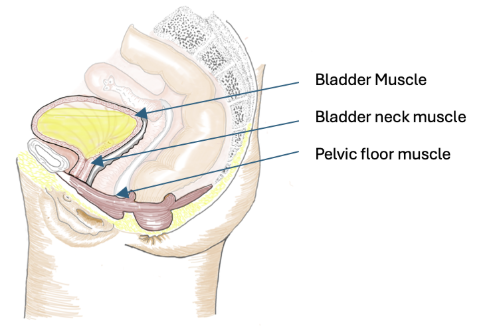
Accomplishing these jobs requires coordination of the:
· Bladder muscle (detrusor) – an elastic muscle that relaxes to allow stretching of the bladder to store urine
· Bladder neck muscle (sphincter) – a ring-like muscle around the bladder neck that squeezes to close the bladder
· Pelvic Floor Muscles – that provide support for the bladder and other pelvic organs
· Nerves – that send signals from the bladder to the brain and back to the muscles about when the bladder is full and when to empty
Incontinence happens when there’s aproblem with the strength, support, nerve signalling,or bladder behaviour. That means that there are several potential different reasons that you might be leaking.
It is normal to get an urge to pee when your bladder fills. This is how our brain tells us our bladder is full, although normally you have plenty of time to empty. Urgency occurs when you cannot postpone it, and the bladder may start to empty before you are ready causing urgency incontinence.
These symptoms are often referred to as OveractiveBladder or OAB. Other common symptoms with OAB include; Frequency– the need to empty very frequently (more than 7 times per day), and Nocturia– having to get up at night more than once to empty. OAB is often due to problems with the nerve signalling that connects the brain to the bladder or bladder muscle overactivity.
Stress Urinary Incontinence refers to leaking when you cough, sneeze, laugh, jump, or lift something. This is the most common type of incontinence in women.
When we cough, laugh, of jump it causes a sudden increase in pressure in your abdomen that pushes down on the bladder causing an increase in the bladder pressure. A strong bladder neck muscle and pelvic floor muscle keep the urethra closed during these increases. If your pelvic floor and bladder neck muscle can’t counter that pressure, a little urine escapes.
There are a number of life events that can compromise the bladder neck and pelvic floor muscles. During Pregnancy the growing baby puts weight on your pelvic floor, and bladder, and changes in hormones soften ligaments reducing support. During Childbirth the baby’s head in the pelvis and vaginal delivery, causes stretching or tearing of the muscles and connective tissue, and can damage nerves. This is especially true during an instrumental birth (forceps or vacuum). Menopause can also lead to incontinence. The hormone estrogen keeps the tissues of the urethra and bladder thick elastic and well supported. As estrogen levels drop during menopause, the tissues thin and the urethral “seal” may weaken. High Impact Exercise can also worsen incontinence. The repeated downward pressure on the bladder during activities like running, jumping and heavy lifting become too much for the bladder neck muscle to counter, and leakage occurs. Similarly, Obesity can create extra weight on the abdominal wall that increases the pressure on the bladder and bladder neck, overcoming their ability to hold in urine.
In short: anything that stretches, weakens, overloads the pelvic floor can lead to stress leaks
Mixed incontinence refers to leaking with exertion and with Urgency. Many women have both Urgency incontinence and Stress incontinence. For example, you might leak when you sneeze and also have to rush to the bathroom with little warning. Treatment needs to address both components. It is not uncommon to have two types of incontinence at the same time, which is important to know when considering treatment.
With overflow incontinence, in addition to leakage, you might feel that you don’t empty completely, have a weak stream, experience dribbling, or have to get up at night frequently. This is less common in women. The bladder isn’t emptying properly and stays overfull ,causing urine to leak out as it overflows.
There are many reasons for poor bladder emptying. There could be obstruction of the bladder neck due to pelvic organ prolapse, or severe constipation. It could also be due to injury to the nerves of the bladder due to diabetes, prior surgery, or spinal problems. There are also some medications that can affect nerve signalling.
This is more of an issue of access and mobility rather than a problem with the bladder. The bladder may work fine, but there is a problem with logistics. For example, women with mobility issues due to arthritis, injury, or frailty, or those with cognitive difficulties due to dementia or stroke, may have problems getting to the toilet even though their bladder is working normally. This can be exacerbated by barriers like bathrooms that are far away, or not enough breaks during work. It can also be aggravated by medications such as diuretics or water pills, and pain medications.
It is tempting to just wear pads and get on with it, especially when you’re juggling work, family, and everything else. But there are effective treatments and knowing the cause determines the best solution. Masking the symptoms without understanding their cause will lead to ineffective and delayed treatment and prolong the impact on your confidence and quality of life. Instead, you can find out what is behind your symptoms by speaking with a incontinence specialist and getting started on treatment. All of the different varieties of incontinence have conservative, treatments that are often effective without medicine or surgery.
You should consider speaking to a healthcare professional trained in the management of urinary incontinence if:
· You leak regularly (even “just with exercise” or “just a little”)
· It is affecting your work, relationships, exercise, or sleep
· The problem is getting worse
· You have pain, burning or blood in your urine
You don’t need to know what type of incontinence you have before you seek help, that’s the clinician’s job. A typical assessment begins with a detailed conversation about your symptoms, medical history, and medications. Some women will also need a urine test or an exam.
Understanding why this is happening to you is the first step to take back control of your bladder. You deserve care options, and the ability to focus on your work, family, and goals - rather than focusing on where the nearest bathroom is.